Your marketing team just spent $50,000 on a campaign.
Social media ran one message. Email sent another. Paid search? Completely different angle. The result? Confused customers. Wasted budget. Zero attribution.
Sound familiar?
Here’s the truth: siloed marketing is hemorrhaging your ROI. And in 2026, you can’t afford it anymore.
Research shows that integrated marketing strategies deliver up to 50% higher ROI than disconnected campaigns. Brands using omnichannel approaches see a 287% higher purchase rate than single-channel efforts. That’s not incremental improvement. That’s transformation.
So why are most brands still operating like it’s 2015?
The Real Cost of Disconnected Campaigns
Let’s call it what it is. Marketing silos.
Your paid media team doesn’t talk to your content team. Your social strategist has no idea what your email automation is sending. Your programmatic advertising agency runs campaigns that contradict your organic messaging.
The damage compounds fast.
Budget inefficiency. When channels operate independently, you duplicate efforts and overspend on overlapping audiences. No visibility means no smart allocation.
Inconsistent messaging. Customers experience your brand across six, seven, eight touchpoints before converting. If each touchpoint tells a different story, you erode trust instead of building it.
Unmeasurable impact. Without unified attribution, you can’t identify what actually drives conversions. Last-click models give credit to the final touchpoint while ignoring the seven interactions that made the sale possible.
The numbers don’t lie. Brands stuck in siloed operations waste between 20-40% of their marketing budget on redundancies, misalignment, and poor attribution.
That stops now.
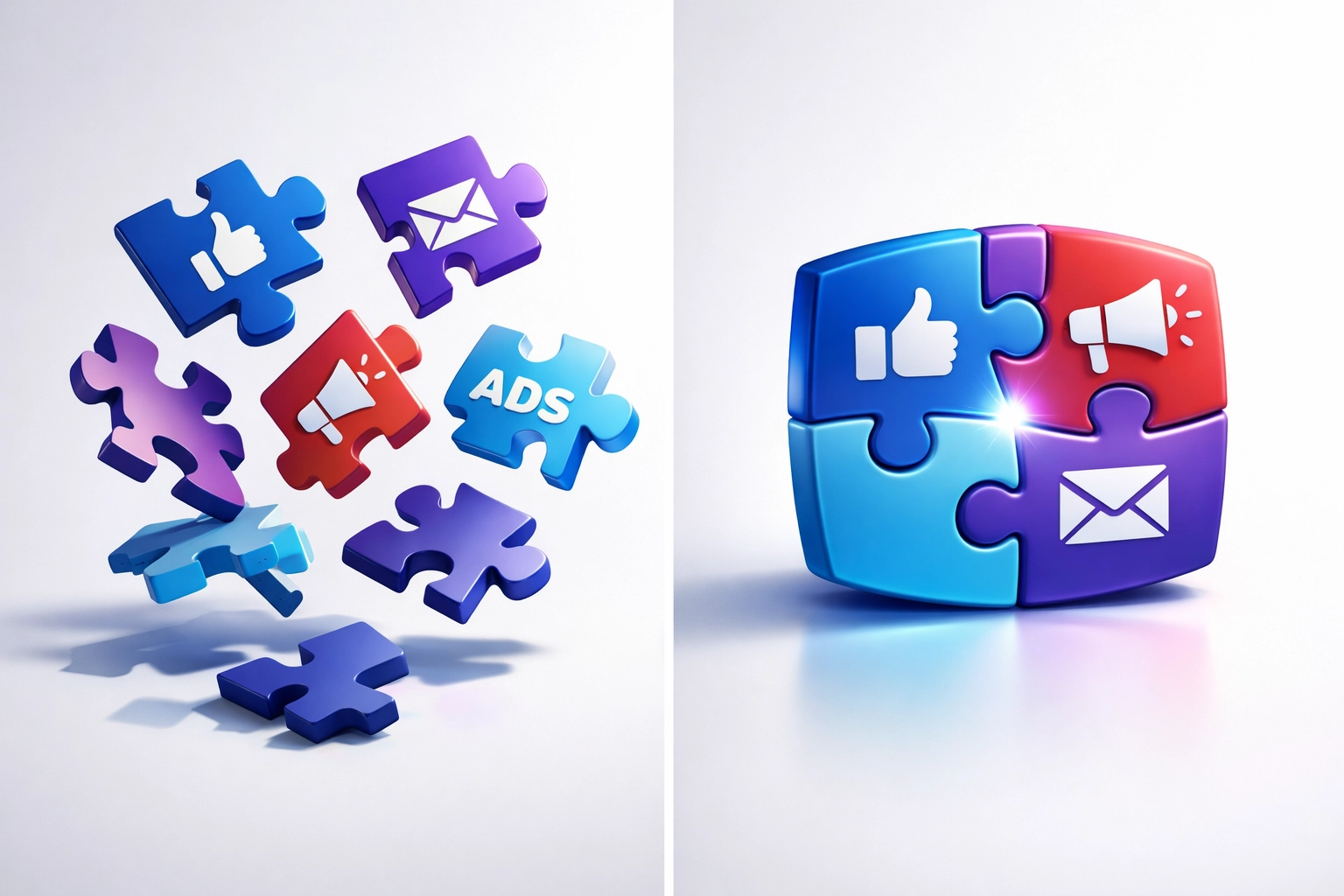
The Integrated Marketing Playbook: Four Pillars That Drive Real ROI
We’ve rebuilt marketing strategies for dozens of brands. The pattern is clear. High-performing campaigns share four integrated pillars.
Pillar 1: Unified Data as Your Single Source of Truth
Everything starts with data.
Your CRM becomes the central nervous system. Every touchpoint: website forms, ad clicks, email opens, social engagement, sales conversations: feeds into one unified dashboard. No more spreadsheet gymnastics. No more guessing.
Multi-touch attribution reveals the real customer journey. That LinkedIn ad didn’t convert directly, but it made the Google search ad 3x more effective. See the whole picture. Allocate budget accordingly.
AI tools now optimize budget allocation in real-time. When your search campaign exceeds target CPA, algorithms automatically shift dollars to higher-performing channels. Dynamic. Responsive. Profitable.
This is Insights & Strategy at the core: using data to make every dollar accountable.
Pillar 2: Cross-Channel Content That Actually Talks to Itself
Stop creating content in silos.
Start with a unified creative brief that every team: SEO, content, paid, social, design: works from. One core message. One target persona. One conversion goal.
Then amplify it strategically.
Someone watches 50% of your YouTube video? Retarget them with a case study ad on LinkedIn. They engage with your Instagram post? Trigger an email sequence with deeper insights. They visit your pricing page? Show them testimonial ads across the web.
This is where Content Creation and Programmatic Advertising merge into something powerful. Dynamic retargeting that feels personalized, not creepy.
Consistency across channels doesn’t mean boring repetition. It means reinforcing the same core story through different mediums, meeting people where they are, building recognition and trust with every impression.
Pillar 3: Experience Design That Connects Every Touchpoint
The customer journey isn’t linear anymore. It’s messy. It’s multi-device. It’s omnichannel chaos.
Your job? Make it feel seamless.
Experience Design means architecting every touchpoint: from first impression to post-purchase: as part of one cohesive journey. The social ad visual language matches the landing page. The landing page CTA flows naturally to the email nurture sequence. The email design mirrors the brand experience on your site.
Fluid technology architecture makes this possible. Marketing automation platforms (MAPs), CRMs, and ad platforms communicate in real-time. When someone fills out a form, they’re automatically excluded from awareness ads and added to conversion campaigns.
Build dashboards that show channel interplay. “Content engagement increased paid search conversion rates by 15%.” That’s actionable intelligence.
Pillar 4: Predictive Analytics That Drive Proactive Decisions
Stop reacting. Start predicting.
Use unified data to forecast performance. Refine lead scoring models with behavioral signals from every channel. Focus budget on acquiring prospects who match your highest-value customer profiles.
Agencies implementing agentic marketing workflows: AI-driven optimization that acts autonomously: are seeing 20-30% ROI lifts in 2026.
The shift is profound. You move from “Let’s see what worked last quarter” to “Here’s exactly where we should invest next quarter based on predictive modeling.”
Implementation: How to Actually Build This
Theory is easy. Execution is where most brands stumble.
Start with alignment. Get sales and marketing in the same room. Literally. Integrated sales enablement shortens sales cycles and improves lead-to-close rates for B2B companies. When marketing understands what sales needs and sales feeds insights back to marketing, ROI multiplies.
Connect your tech stack. Audit your current platforms. What integrates natively? What needs API connections? What’s redundant? Build a connected ecosystem where data flows automatically, not manually.
Define unified KPIs. Stop measuring channel performance in isolation. Track ROMI (Return on Marketing Investment), cost per lead, customer acquisition cost (CAC), conversion rates, and multi-touch attribution. Tie marketing spend directly to pipeline value and closed revenue.
Test, measure, optimize. Launch integrated campaigns in phases. Use A/B testing across channels simultaneously to understand interaction effects. Continuously refine based on real performance data, not assumptions.
This is the playbook progressive brands use. It’s detailed. It’s systematic. It requires commitment.
And it works.

The ROI Impact: What Integration Actually Delivers
Let’s get specific.
Brands implementing integrated marketing strategies see 50% higher ROI than those running disconnected campaigns. The data is consistent across industries.
Omnichannel campaigns drive 287% higher purchase rates than single-channel efforts. That’s not margin of error. That’s market dominance.
Companies using AI-driven integrated workflows report 20-30% ROI lifts in the first six months of implementation.
Here’s what that looks like in practice: A Q1 integrated campaign influences $2M in pipeline and closes $500K in revenue. That’s a 5:1 ROMI: industry average. But with optimization, top performers hit 10:1 or higher.
The difference? Integration. Attribution. Optimization. Execution.
Stop viewing channels as separate entities. Start architecting unified systems where data, content, and budget flow dynamically based on real-time performance.
That’s the future. And it’s already here.
Ready to Stop Wasting Budget?
We’ve guided brands through this transformation dozens of times. Programmatic Advertising. Insights & Strategy. Content Creation. Experience Design. All four pillars working as one integrated engine.
Let the people in. That’s our philosophy. Inclusive strategies that reach everyone, guided by data, executed flawlessly.
Your campaigns shouldn’t compete with each other. They should amplify each other.
Book a strategy session with the Skymattix team and let’s build your integrated marketing playbook for 2026. No more wasted budget. No more disconnected messaging. Just measurable, scalable, predictable ROI.
Frequently Asked Questions
What is an integrated marketing strategy?
An integrated marketing strategy unifies all marketing channels: paid ads, content, email, social, SEO: under one cohesive plan with shared data, consistent messaging, and coordinated execution. Instead of running disconnected campaigns, every channel works together to guide customers through a seamless journey, resulting in higher ROI and better attribution.
How much ROI improvement can I expect from integrated marketing?
Research shows integrated marketing campaigns deliver up to 50% higher ROI than siloed efforts. Brands using omnichannel strategies see 287% higher purchase rates. Companies implementing AI-driven integrated workflows report 20-30% ROI lifts within six months. Actual results depend on implementation quality and industry, but the improvement is significant across the board.
What’s the difference between multi-channel and integrated marketing?
Multi-channel marketing uses multiple platforms but often operates them independently: different teams, different messages, disconnected data. Integrated marketing coordinates all channels as one unified system with shared goals, consistent messaging, unified attribution, and data flowing between platforms. It’s the difference between running five separate campaigns and running one campaign across five channels.
How do I measure the success of integrated campaigns?
Track ROMI (Return on Marketing Investment), multi-touch attribution, cost per lead, customer acquisition cost (CAC), and conversion rates across all channels. Use unified dashboards that show channel interaction: like how content consumption affects paid search conversion rates. Tie marketing spend directly to pipeline value and closed revenue, not just channel-specific vanity metrics.
Do I need a full-service agency to implement integrated marketing?
While you can build integrated strategies in-house, it requires expertise across multiple disciplines: programmatic advertising, content strategy, CRM integration, experience design, and data analytics. Most brands find that partnering with a full-service digital marketing agency accelerates implementation and delivers better results because all specialists are already aligned under one strategic framework.